Most Claude Code vs Codex comparisons are a weekend of toy tasks or a lab’s test set. This one is a git log.
From 3 to 20 November 2026, coding agents wrote more than nine in ten commits to Amia, a Mac and iPhone app: 9,392 commits trace to 433 Claude Code sessions and 57 Codex sessions (3 more to Antigravity). Every one landed on the same main branch, through the same landing queue, under the same rule file (AGENTS.md is a link to CLAUDE.md). Each commit was traced to the session transcript that landed it, and a compile check recorded a verdict for 3,725 of them.
That lets us ask something a benchmark can’t: on a real, moving codebase, how often does each agent break the build, and how often does it fix one?
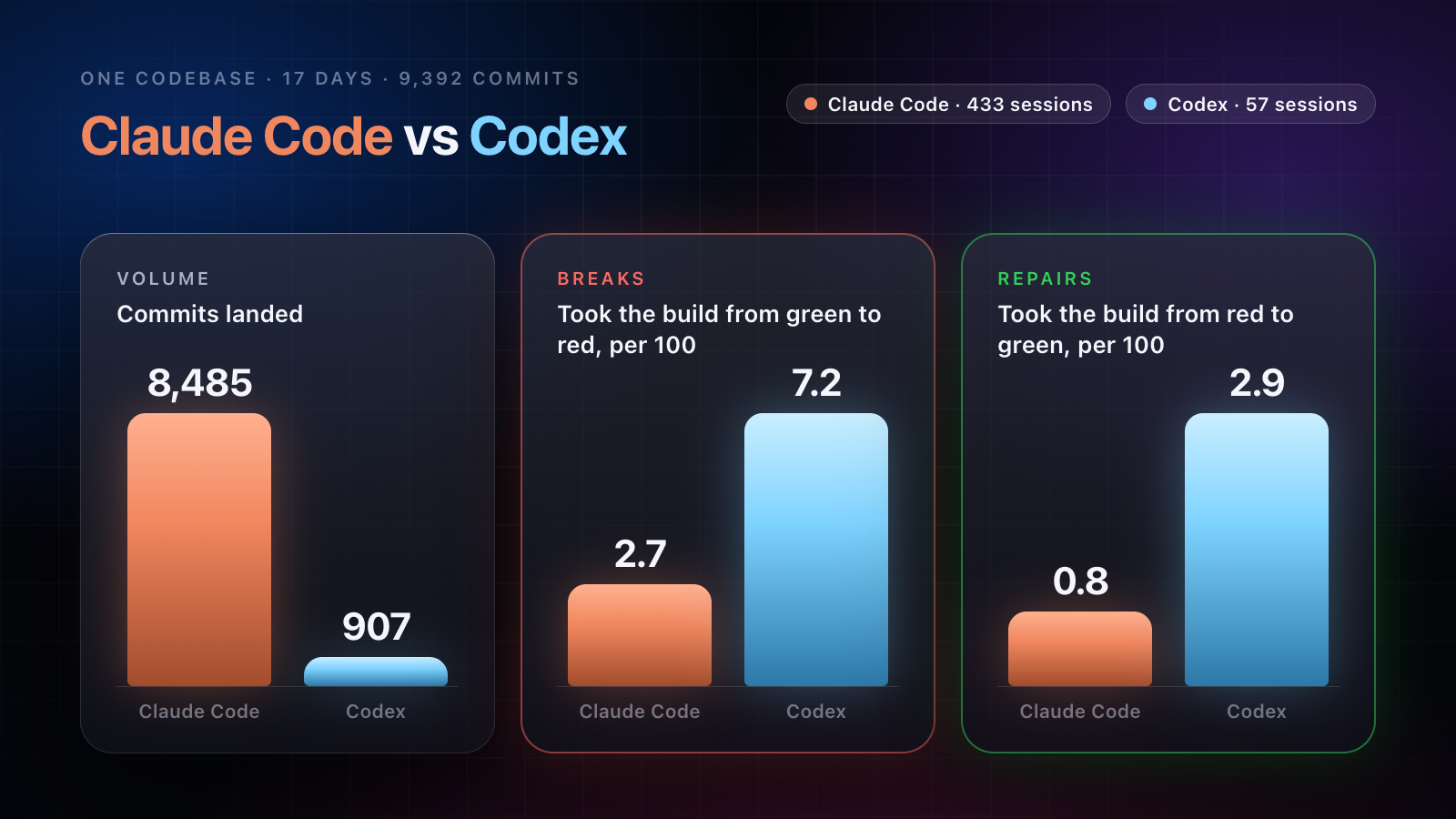
The numbers
| Claude Code | Codex | |
|---|---|---|
| commits (sessions) | 8,485 (433) | 907 (57) |
| commits with a compile verdict | 2,966 | 416 |
| … whose parent commit had one too | 1,432 | 278 |
| took the build from green to red | 38 (2.7 per 100) | 20 (7.2 per 100) |
| took the build from red to green | 11 (0.8 per 100) | 8 (2.9 per 100) |
Only a commit whose parent was also measured can show a transition, so the last two rows read from those pairs.
- Claude Code broke a green build less often: 2.7 times per 100 commits, against Codex’s 7.2.
- Codex turned a red build green more often: 2.9 per 100, against Claude Code’s 0.8.
- Claude Code did most of the work: about nine commits for every one of Codex’s.
What it does not show
Read this before you quote the table.
- It is not a controlled trial. The two agents got different tasks. A session fixing a red build counts as a repair for whichever agent was given that job.
- A commit can turn the build red by composing with someone else’s. Two correct changes can conflict once both land.
- The build was red most of the time, on purpose. This codebase lands first and verifies after: a broken build is repaired by the next commit, never by a revert.
mainfailed to compile at 1,979 of the 3,725 measured commits. The number to read is the transition, green to red or red to green, never the colour. - 820 commits traced to no session, and Antigravity’s 3 are too few to say anything.
Agents fixing each other
In the same 17 days, one agent’s session landed a fix naming another session’s commit 17 times (8 sessions, a median of 72 minutes after the commit it fixed). A session fixed its own commit 97 times (a median of 22 minutes).
One of the 17, on 13 November: an agent added a settings row to the iPhone app, missed the Mac app, and its session ended. Later a Mac deploy died on the same kind of slip. Another agent read the error, found the first one too, and landed the fix 104 minutes after the commit it repaired.
None of the 17 crosses vendors: in this record, Claude Code fixed Claude Code and Codex fixed Codex. “One vendor’s agent checks the other’s” is something we use, not something this history proves.
What we took from it
Which agent mattered less than three things around it:
- Every commit traced to a session. When something broke, we knew which agent, which task and which transcript.
- A machine judged every commit. No agent’s own “done” counted until the compiler agreed.
- A broken build was everyone’s to fix. The 17 cross-session repairs happened because the next agent to hit the break owned it.
The app they were building
The codebase is Amia, an app that runs both.
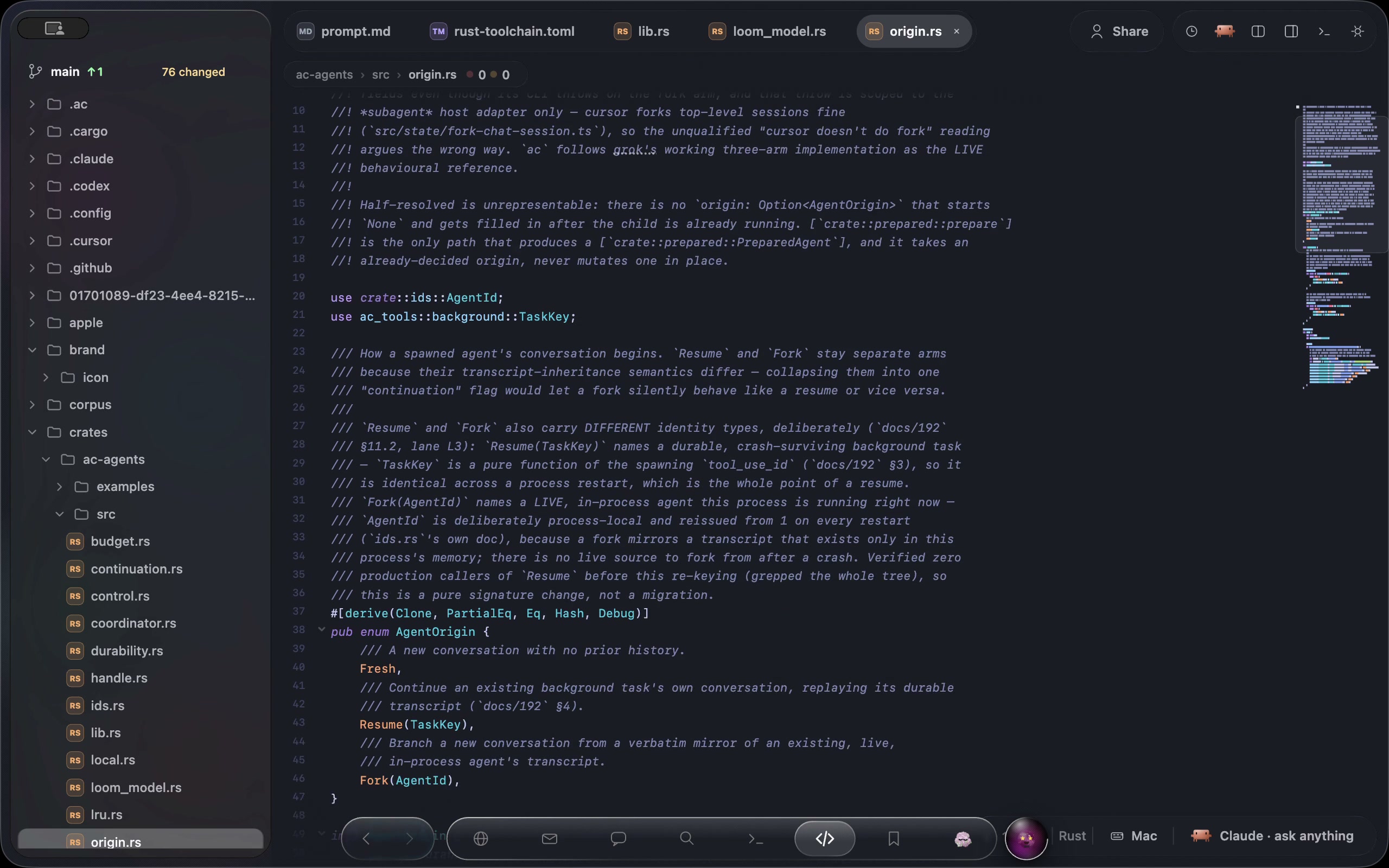
Amia puts Claude Code, Codex, Cursor, Grok Build, Antigravity, Muse Code and its own agents in one list: what needs you, what’s working, what’s done. Put chats in a crew and one agent can bring in another, so Claude Code can start Codex to check its fix. Anything that matters waits for your yes, on your Mac or on your iPhone’s Lock Screen. How to set that up is in How to use Claude Code and Codex together. It also works over every app on your Mac, with ⌥Space anywhere and a bar of actions on any text you select, and it pays or signs in without ever seeing your card or password.
It runs on the AI accounts you already have: Amia uses them first and never counts them.